Selecting an existing heat sink extrusion can be one of the fastest and most cost-effective ways to move a thermal project toward production.
However, the extrusion profile does not need to look exactly like the finished heat sink shown on your drawing.
In many projects, the extrusion is only the starting shape. It can later be cut to length, face milled, drilled, tapped, slotted, pocketed, anodized, or otherwise machined into the finished component.
The more important question is whether the basic extruded cross-section provides the right thermal and mechanical foundation for the project.
This guide explains how to evaluate an existing heat sink extrusion profile, which dimensions matter most, what can be changed after extrusion, and when developing a new extrusion die makes more sense.
Why Check Existing Extrusion Profiles First?
A custom extrusion die gives engineers considerable design freedom, but it is not always necessary.
If an existing profile already provides suitable width, fin height, fin spacing, base thickness, and general geometry, it can often be adapted to the finished design through secondary machining.
Using existing tooling can help reduce development time and initial tooling cost, particularly for prototypes, smaller production runs, or projects where a suitable cross-section is already available.
At XINXIANG, our growing heat sink extrusion profile library allows engineers and buyers to search existing tooling by dimensions and compare available cross-sections before considering a completely new extrusion.
If an existing tool is suitable for the project and can be used directly, new die development may not be required. Final tooling suitability, tolerances, availability, and production requirements are confirmed during quotation.
The key point is that an existing profile should be treated as a manufacturing starting point, not necessarily as the finished component.
Start With the Extruded Cross-Section
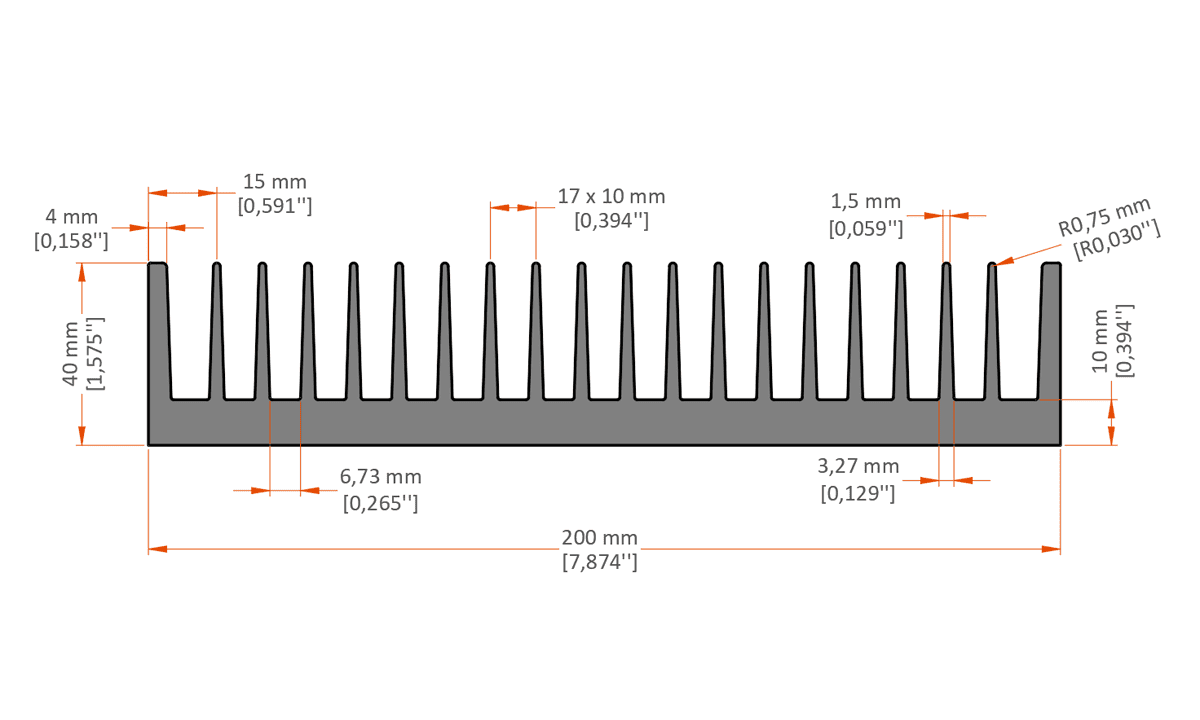
Before comparing profile numbers, separate the dimensions created by the extrusion die from the features that can be added afterward.
The extrusion die determines the continuous cross-section, including:
- Overall width
- Overall height
- Base thickness
- Fin height
- Fin thickness
- Fin pitch and spacing
- Number and arrangement of fins
- Channels or other continuous profile features
Once the profile has been extruded, these basic cross-sectional features normally cannot be changed freely.
By contrast, the dimension in the extrusion direction—the final heat sink length—is usually much easier to customize because the long extrusion can be cut to the required length.
This distinction is important. A profile that is longer than your finished heat sink is normally easy to address. A profile with insufficient base thickness, inadequate width, or completely unsuitable fin spacing is a much more fundamental problem.
1. Overall Width: Look for a Practical Starting Size
Overall width is usually one of the first parameters to check when searching an extrusion profile library.
The profile should provide enough usable width for the heat source, mounting holes, thermal spreading area, mechanical attachment points, and any CNC features required near the sides of the base.
A profile that is slightly wider than the finished component may sometimes be reduced through machining, depending on its geometry.
However, machining cannot turn an extrusion that is too narrow into a wider heat sink.
For this reason, it is generally better to begin with enough usable base width rather than choose a profile that is already undersized.
Do Not Compare Width Alone
Two profiles with the same overall width can provide very different usable mounting areas.
One profile may have fins extending across almost the entire base, while another may contain thicker side sections or open mounting areas that provide easier access for drilling, tapping, clamping, or component installation.
Always review the actual cross-section rather than selecting a heat sink by overall width alone.
2. Overall Height: Taller Is Not Automatically Better
Overall profile height normally includes both the base and the fins.
Taller fins can provide additional cooling surface area, but thermal performance does not continue to improve simply by increasing fin height.
Fin effectiveness also depends on airflow, fin thickness, fin spacing, heat sink length, material conductivity, orientation, and the temperature difference between the heat sink and the surrounding air.
Very tall fins can also increase weight, extrusion difficulty, and the risk of damage or deformation during production, machining, handling, and transportation.
For this reason, choose a profile height that fits the actual cooling environment rather than simply selecting the tallest profile that can fit inside the enclosure.
3. Fin Spacing Must Match the Airflow
One of the most common heat sink selection mistakes is assuming that more fins always mean better cooling.
More fins increase surface area, but they also reduce the space available for air to move between them.
Natural Convection
For passive cooling, heated air must rise through the fin channels primarily by buoyancy.
If the fins are packed too closely, natural airflow can become restricted and some of the additional surface area becomes less effective.
Fin orientation is also important. For many straight-fin heat sinks, arranging the fin channels so that warm air can rise freely supports natural convection.
For more information on fanless cooling, see our passive heat sink guide.
Forced-Air Cooling
With fans or blowers, closer fin spacing may be practical because airflow is actively driven through the heat sink.
However, greater fin density also increases airflow resistance. The performance of the final system therefore depends on the heat sink together with the fan or blower, enclosure restrictions, air bypass, filters, neighboring components, and airflow direction.
For forced-air projects, the heat sink and airflow source should be considered together as an active cooling system.
For a deeper look at how airflow, fin length, and pressure drop affect the gap between fins, see our guide to heat sink fin spacing.
4. Base Thickness Matters for More Than Strength
Base thickness is another important parameter when selecting an existing extrusion profile.
The base performs several functions at the same time.
Heat spreading. Heat entering from a relatively small electronic component or power module must spread laterally through the base before the full fin area can contribute effectively.
Mechanical support. The base supports the fins, mounting hardware, and assembly loads.
CNC machining allowance. Face milling, pockets, counterbores, threaded holes, recesses, and other machining features all remove material from the original extrusion.
Mounting-surface preparation. Critical thermal interfaces may require additional machining to create the specified mounting surface.
A thicker base can provide better heat spreading and additional machining flexibility, but it also increases weight, aluminum consumption, and cost.
The thickest available base is therefore not automatically the best choice.
Be Careful With Profiles That Are Too Thin
Material can normally be removed from an extrusion, but base thickness cannot simply be added later.
If the finished heat sink requires deep pockets, threaded holes, recesses, or significant face machining, make sure the starting profile leaves sufficient material for those operations.
This is particularly important for power electronics. Our IGBT heat sink selection guide explains how heat spreading and the module-to-heat-sink interface influence the complete thermal path.
5. The Existing Profile Does Not Need to Match the Finished Part Exactly
This is one of the most important concepts when searching an extrusion library.
Suppose the finished heat sink requires a specific cut length, several threaded mounting holes, a machined component interface, two pockets, cable-clearance slots, locally removed fins, and black anodizing.
You do not need to find an extrusion that already contains all of these details.
The extrusion mainly needs to provide a suitable continuous cross-section. Many final features can be produced afterward.
An existing extruded heat sink can often be customized through:
- Saw cutting to the required length
- CNC face milling
- Drilling and tapping
- Counterboring
- Pocket milling
- Slot machining
- Local fin removal
- End machining
- Surface finishing
- Hardware or component assembly
This is why an existing extrusion that initially looks only “close” to the final drawing may still be a very practical manufacturing option.
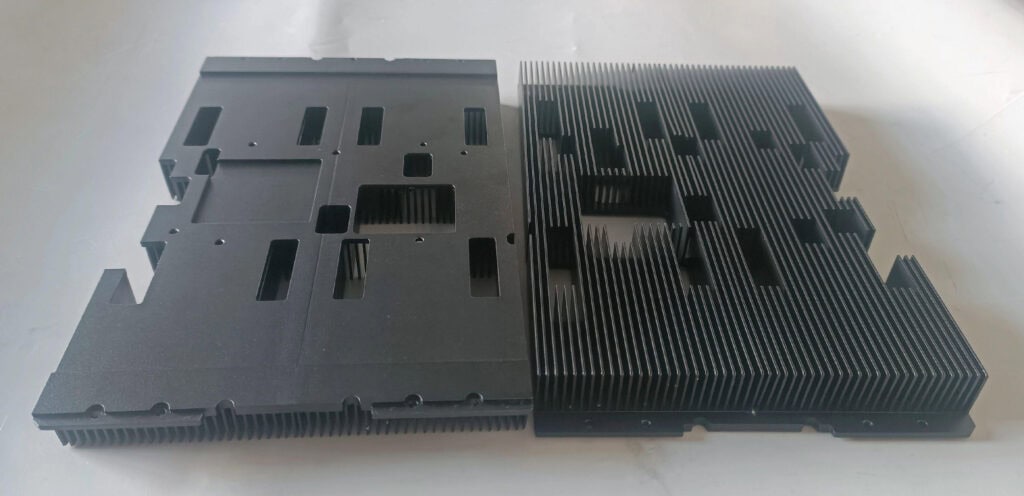
6. Know What CNC Machining Can—and Cannot—Fix
Secondary machining provides considerable flexibility, but it should not be used to compensate for a fundamentally unsuitable extrusion.
Features That Are Often Practical to Add
Depending on the profile geometry, CNC machining can commonly create mounting holes, threads, slots, pockets, counterbores, flat mounting areas, local clearances, shortened fins, removed fin sections, and other mechanical features.
When a Different Extrusion Is Usually Better
Machining becomes less practical when the design requires a major change to the continuous cross-section.
Examples include increasing the base thickness, increasing the overall width, adding a large number of continuous fins, changing the entire fin pitch, or substantially changing the fin structure across the full extrusion length.
Trying to force the wrong profile into the finished design through extensive CNC machining can eliminate the cost and lead-time advantages of using existing tooling.
A good existing profile should simplify the manufacturing route—not create an unnecessarily complicated one.
7. Extrusion Tolerances and Machining Tolerances Are Different
An aluminum extrusion should not automatically be treated as a fully machined precision component.
Extrusion production involves dimensional considerations such as profile dimensions, straightness, twist, and flatness. Critical surfaces or tightly controlled features may therefore require secondary machining.
This is especially important when the heat sink interfaces directly with power modules, semiconductor assemblies, LED boards, power supplies, thermal interface materials, or precision mechanical components.
If your drawing contains critical flatness or dimensional requirements, identify the functional surfaces clearly.
In many cases, it is more economical to maintain normal extrusion tolerances for the overall profile and machine only the areas that actually require tighter control.
8. Consider the Final Machining Before Selecting the Profile
A profile can look suitable thermally but become difficult or expensive to manufacture once CNC requirements are considered.
Tool Access
Can the cutter reach the required pockets, slots, mounting areas, and holes without interference from tall fins?
Clamping
Is there enough solid material to hold the part securely during machining? Thin fins should not become the primary clamping surfaces.
Hole and Thread Depth
Does the base contain enough material for the required hole depth and thread engagement?
Machining Datum
Is there a practical reference surface that allows the part to be positioned and inspected consistently?
Deformation Risk
Wide profiles, thin bases, and tall fins can be more sensitive to distortion during extrusion, cutting, clamping, machining, or handling.
Considering these manufacturing details before the profile is selected can prevent unnecessary redesign later.
9. Compare the Profile With the Heat Source, Not Just the Enclosure
The enclosure dimensions tell you whether a heat sink physically fits. They do not tell you whether it can cool the electronic device adequately.
Before selecting a profile, consider:
- Total heat dissipation
- Heat-source footprint and location
- Maximum ambient temperature
- Allowable component temperature
- Natural or forced airflow
- Airflow direction
- Heat sink orientation
- Required thermal performance
- Thermal interface requirements
- Number and location of heat sources
A profile should therefore be selected by combining the mechanical envelope with the actual thermal operating conditions.
10. When Does a New Extrusion Die Make More Sense?
Existing tooling is valuable when the available cross-section is already reasonably close to the project requirements.
However, an existing profile should not become a design constraint when it introduces excessive machining, unnecessary weight, poor airflow, or compromised thermal performance.
A new custom extrusion may be the better option when:
- No existing profile provides sufficient width or height
- The required base thickness is unavailable
- Fin spacing is poorly matched to the cooling environment
- The project needs a substantially different continuous fin structure
- Large amounts of material would need to be machined away
- Extensive CNC work makes the existing profile uneconomical
- Weight needs to be reduced for repeat production
- Continuous mounting channels or other features should be integrated into the profile
- Production quantity justifies dedicated tooling
A well-designed custom extrusion can sometimes reduce total manufacturing cost by incorporating useful features directly into the cross-section and reducing later machining.
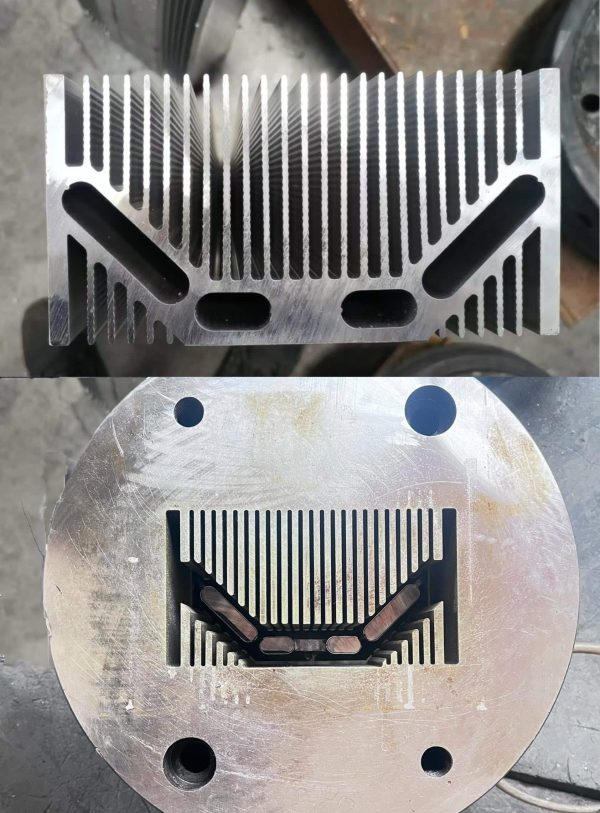
At XINXIANG, if none of the existing profiles is suitable, we can review your drawing and evaluate a new custom extrusion. Custom die costs are typically competitive, so developing a dedicated profile can still be practical when it produces a cleaner long-term manufacturing solution.
A Practical Heat Sink Profile Selection Workflow
The following process provides a practical starting point when reviewing existing heat sink extrusion tooling.
| Step | What to Check | Why It Matters |
|---|---|---|
| 1 | Required Envelope | Establish the maximum allowable width, height, and finished length |
| 2 | Profile Width | Confirm sufficient mounting area and lateral heat-spreading space |
| 3 | Overall Height & Fin Geometry | Make sure the profile fits the available space and cooling environment |
| 4 | Base Thickness | Check heat spreading, mechanical support, and CNC machining allowance |
| 5 | Fin Spacing & Airflow | Match the fin structure to natural convection or forced-air cooling |
| 6 | Final CNC Machining | Review holes, threads, pockets, slots, flatness, and local fin removal |
| 7 | Surface Finish | Confirm anodizing, conversion coating, painting, or other finishing requirements |
| 8 | Production Quantity | Compare the economics of existing tooling with developing a dedicated extrusion die |
| 9 | Drawing Review | Confirm tolerances, manufacturability, machining sequence, and final cost |
The objective is not to find an extrusion that already looks exactly like the finished product.
The objective is to find the closest practical cross-section that creates the simplest reliable manufacturing route.
What Information Should You Send When Requesting a Profile?
If You Already Found a Profile
If you have identified a profile in our library, send us:
- XHS profile number
- Required cut length
- Order quantity
- 2D drawing or 3D model, if available
- CNC machining requirements
- Critical tolerances
- Surface finish requirements
- Packaging or assembly requirements, if applicable
The XHS number allows us to identify the existing tooling quickly and review whether it is appropriate for the finished part.
If You Have Not Selected a Profile Yet
You can instead send us:
- Required or maximum width
- Maximum overall height
- Approximate base thickness
- Required finished length
- Heat load
- Heat-source dimensions
- Natural or forced airflow conditions
- Airflow direction, if known
- Estimated order quantity
- Finished-part drawing, if available
We can then compare your requirements with our existing tooling and determine whether an available profile is a practical starting point.
Existing Profile or Custom Extrusion?
There is little benefit in developing a new extrusion die when an existing profile can meet the project requirements with simple secondary machining.
At the same time, there is little value in forcing an unsuitable existing profile into the design if it requires excessive machining or compromises the thermal or mechanical requirements.
A practical decision normally comes down to four questions:
Does the cross-section provide suitable thermal and mechanical capability?
Does it leave enough material for the required machining?
Can it fit the finished mechanical envelope without excessive modification?
Is it more economical than developing a dedicated extrusion for the project?
If the answers are favorable, existing tooling can provide a fast and cost-effective route to production.
If not, developing a custom extrusion may produce a cleaner and more economical long-term solution.
Find a Heat Sink Extrusion for Your Project
XINXIANG maintains a growing library of existing aluminum heat sink extrusion tooling covering a range of widths, heights, base thicknesses, and fin structures.
You can browse our heat sink extrusion profiles and filter the available options by profile dimensions.
If you find a suitable starting profile, send us the XHS profile number together with your required length, quantity, drawing, machining, and finishing requirements.
If none of the existing profiles is suitable, send us your drawing or required dimensions. We can review the project and evaluate a new custom extrusion with competitive tooling costs.
Technical References
For additional technical guidance on aluminum extrusion tolerances, profile design, machining, and finishing, refer to the following industry resources:
- The Aluminum Association — Understanding Aluminum Extrusion Tolerances
- Hydro — Extrusion Design Manual
Actual extrusion tolerances, die feasibility, machining requirements, and thermal performance depend on the profile geometry and individual project specifications.
