Custom liquid cooling plates for power electronics, EV systems, data centers, lasers, energy storage, and high-heat industrial equipment.
A liquid cold plate transfers heat from electronic or electrical components into a coolant flowing through internal tubes or channels. The heated liquid then carries the energy to a radiator, heat exchanger, or chiller elsewhere in the cooling loop.
Liquid cold plates are used when air cooling cannot provide sufficient performance, when the available space is limited, or when high-power components must be kept within a narrow temperature range.
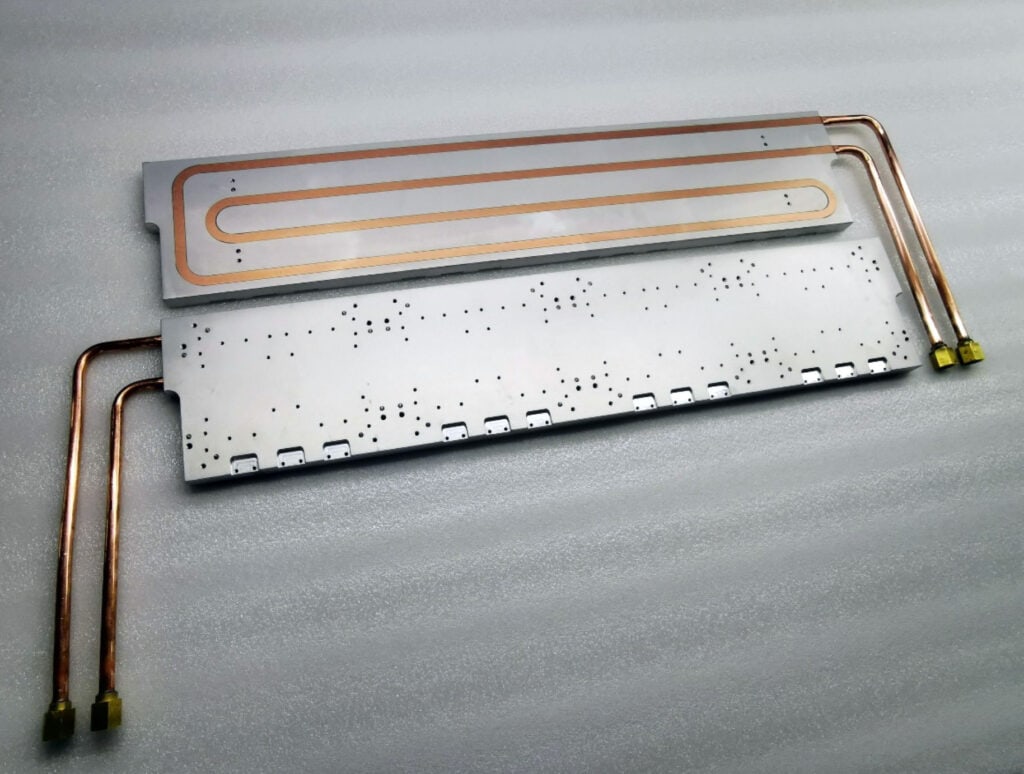
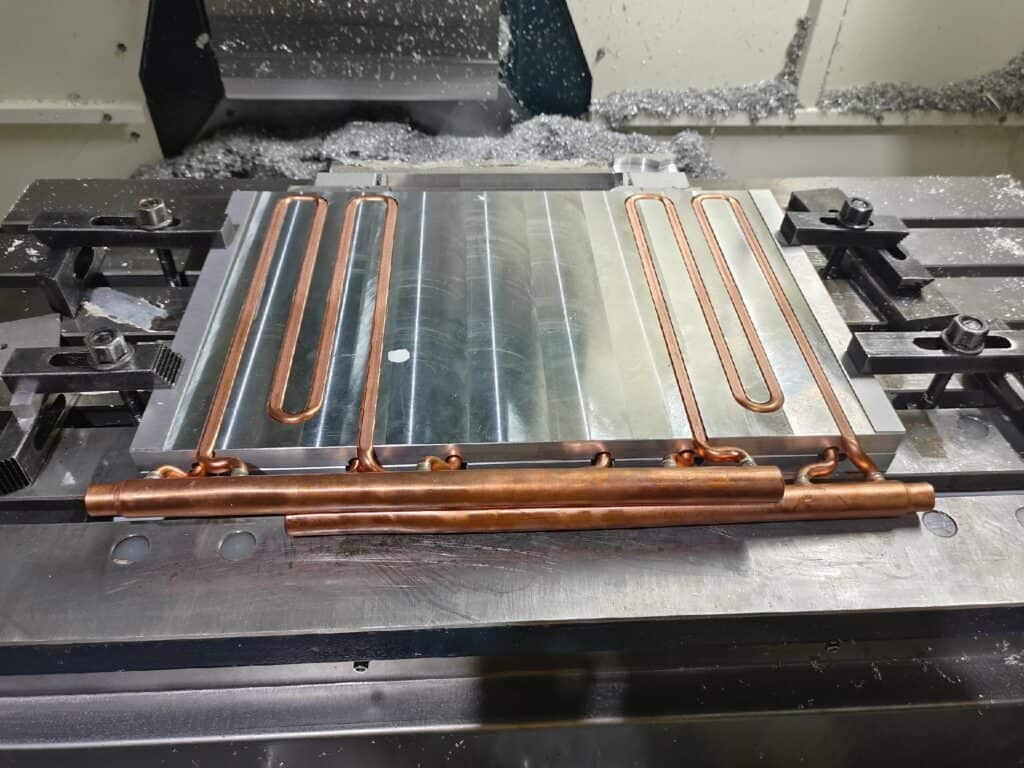
Typical cold plate constructions include machined-channel plates with bonded or brazed covers, tube-in-plate designs, stamped-channel assemblies, and manifold structures. Aluminum and copper are commonly used, depending on conductivity, weight, corrosion compatibility, coolant, pressure, and system requirements.
High Heat Removal Capacity
Liquid cooling can remove concentrated heat from IGBT modules, processors, lasers, batteries, and other high-power components more effectively than many air-cooled arrangements.
Compact Thermal Interface
Internal channels, fins, turbulators, or flow inserts can increase the heat-transfer area beneath critical heat sources without requiring tall external fins.
Improved Temperature Uniformity
The flow path can be arranged to reduce hot spots and provide more uniform temperatures across several components or a large mounting surface.
Flexible Mechanical Design
Mounting holes, pockets, busbar clearances, connector ports, sealing features, and multiple cooling zones can be integrated into one plate.
Lower System Noise
Liquid cooling can reduce dependence on large, high-speed fans near the heat source, although the complete system still requires a pump and heat-rejection device.
The following options are general design categories.
| Item | Typical Options |
|---|---|
| Plate Material | Aluminum, copper, or project-specific material |
| Construction | Machined channel, tube-in-plate, brazed plate, manifold, or custom |
| Flow Path | Serpentine, parallel, multi-pass, meso-channel, or manifold |
| Internal Enhancement | Folded fins, skived fins, turbulators, or custom inserts |
| Coolant | Water, water-glycol mixture, oil, dielectric fluid, or project-specific coolant |
| Ports | Threaded ports, hose barbs, welded fittings, manifolds, or custom connectors |
| Machining | Mounting surfaces, holes, threads, pockets, O-ring grooves, busbar clearances |
| Testing | Dimensional inspection, pressure test, leak test, and flow verification |
| Assembly | Fittings, hoses, sensors, TIMs, insulation, and mounting hardware |
Engineering Note:
The wetted materials, coolant, fittings, pump, heat exchanger, and other loop components must be selected as a compatible system. Mixing incompatible metals—particularly aluminum and copper—without proper corrosion control can lead to galvanic corrosion and reduced service life.
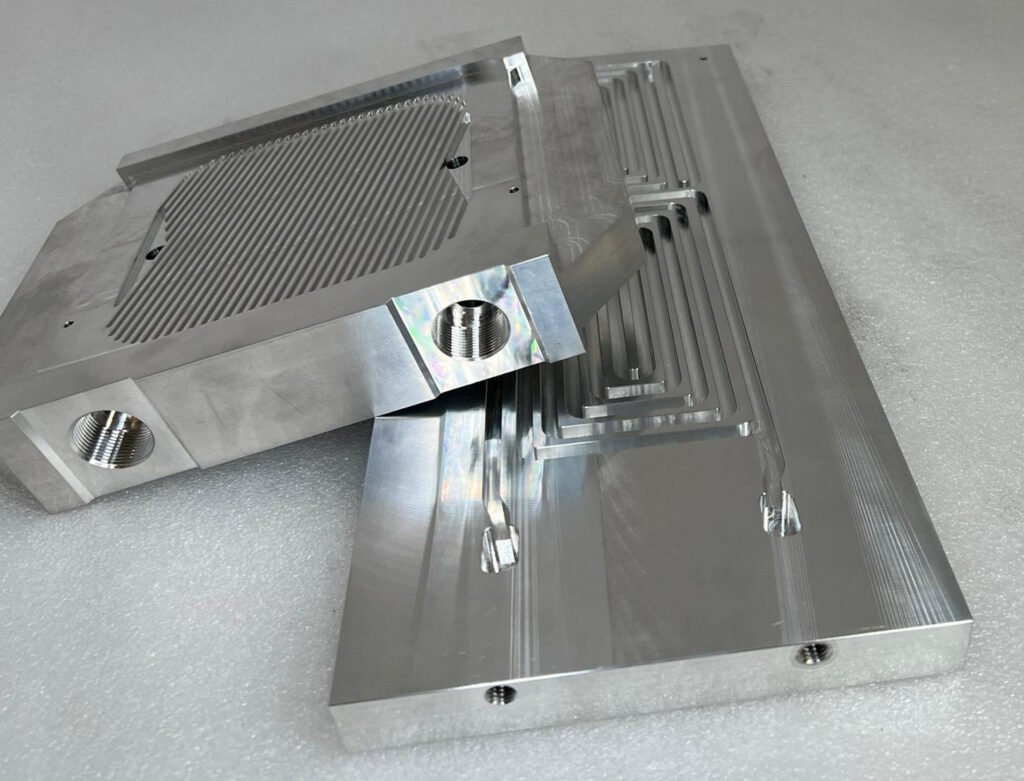
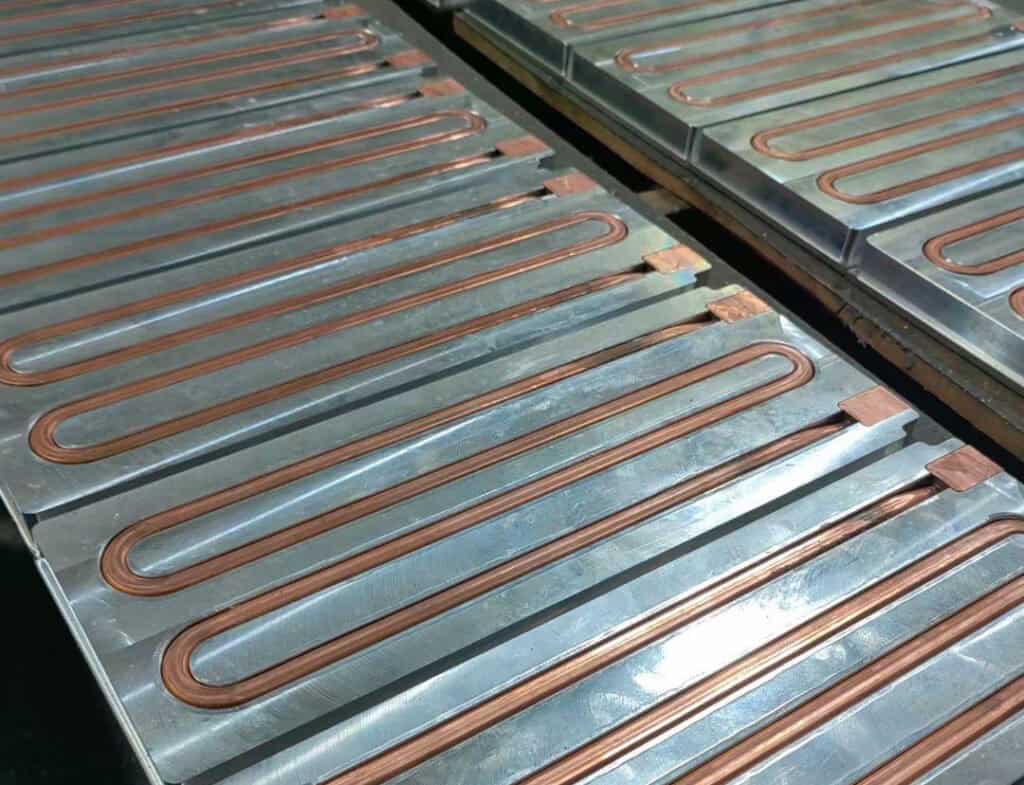
At XINXIANG, we manufacture custom liquid cold plates according to your drawings, heat-source layout, coolant conditions, flow requirements, pressure limits, and production quantity.
Construction Selection
We evaluate machined-channel, tube-in-plate, brazed, manifold, and other project-specific constructions according to heat flux, plate dimensions, operating pressure, reliability requirements, and target cost.
Thermal and Hydraulic Review
The flow path is reviewed according to heat-source locations, coolant type, inlet temperature, flow rate, allowable pressure drop, maximum component temperature, and temperature-uniformity requirements.
CNC Machining
Available machining operations include internal flow channels, component pockets, precision mounting surfaces, threaded ports, O-ring grooves, manifold features, busbar clearances, drilling, tapping, and flatness finishing.
Joining and Port Integration
Covers, tubes, manifolds, fittings, and connectors are joined using a process selected for the plate material, coolant, operating pressure, production volume, and cleanliness requirements.
Inspection and Testing
Dimensional inspection, flatness measurement, pressure testing, leak testing, and flow verification can be performed according to the agreed inspection plan and acceptance criteria.
Application Review
Send us your drawing or 3D model, heat-source map, coolant type, inlet temperature, required flow rate, allowable pressure drop, working pressure, port requirements, quantity, and testing standards.
Design and DFM
We review channel layout, coolant distribution, local hot spots, pressure drop, wall thickness, joining areas, material compatibility, port positions, mounting features, flatness, and machining access.
Prototype and Validation
Prototype cold plates can be manufactured for dimensional, assembly, pressure, leak, flow, and thermal evaluation before volume production.
Inspection and Delivery
After approval, production is completed under controlled work instructions. Cold plates are inspected, tested according to the agreed plan, protected from contamination and damage, and packed for export.
With more than 20 years of heat sink manufacturing experience, XINXIANG supports international OEMs and industrial buyers from early design review through repeat production. Our 6,000 m² facility combines multiple thermal manufacturing processes with CNC machining, finishing, inspection, assembly, and export packaging.
Liquid cooling is generally considered when heat load or heat flux exceeds the practical capability of air cooling, when installation space is restricted, or when tighter temperature uniformity is required.
Machined-channel designs provide strong geometric flexibility, while tube-in-plate designs are often economical for moderate heat loads. Brazed internal-fin designs can offer high performance but require suitable materials, joining capability, and testing.
For a more detailed comparison of embedded-tube, CNC-machined-channel, and brazed constructions, see our guide to liquid cold plate manufacturing methods.
Please provide the heat-source map, coolant type, inlet temperature, flow rate, allowable pressure drop, working pressure, port details, plate dimensions, flatness requirements, and annual quantity.
Testing can be performed according to the agreed test pressure, method, duration, acceptance criteria, and inspection plan.
Yes. We can review the channel layout according to heat-source locations, flow distribution, pressure-drop limits, structural requirements, and manufacturing feasibility.
Fittings, manifolds, hoses, sensors, seals, and mounting hardware can be included according to the agreed assembly requirements.
Yes, we can. We work with several reliable freight forwarders and can arrange door-to-door shipping to most countries — just let us know your delivery address.
We can also use your freight forwarder if you have one.
Send us your drawing, heat-source map, coolant conditions, flow-rate requirements, allowable pressure drop, working pressure, port details, testing requirements, and estimated quantity. We will review the construction, flow path, materials, machining, joining method, and inspection plan before preparing a quotation.
You can also contact our team at sales@heat-sinks.com
Send us your drawing or project requirements. Our team will review your request and typically respond within 24 hours.
You can also email us directly at sales@heat-sinks.com