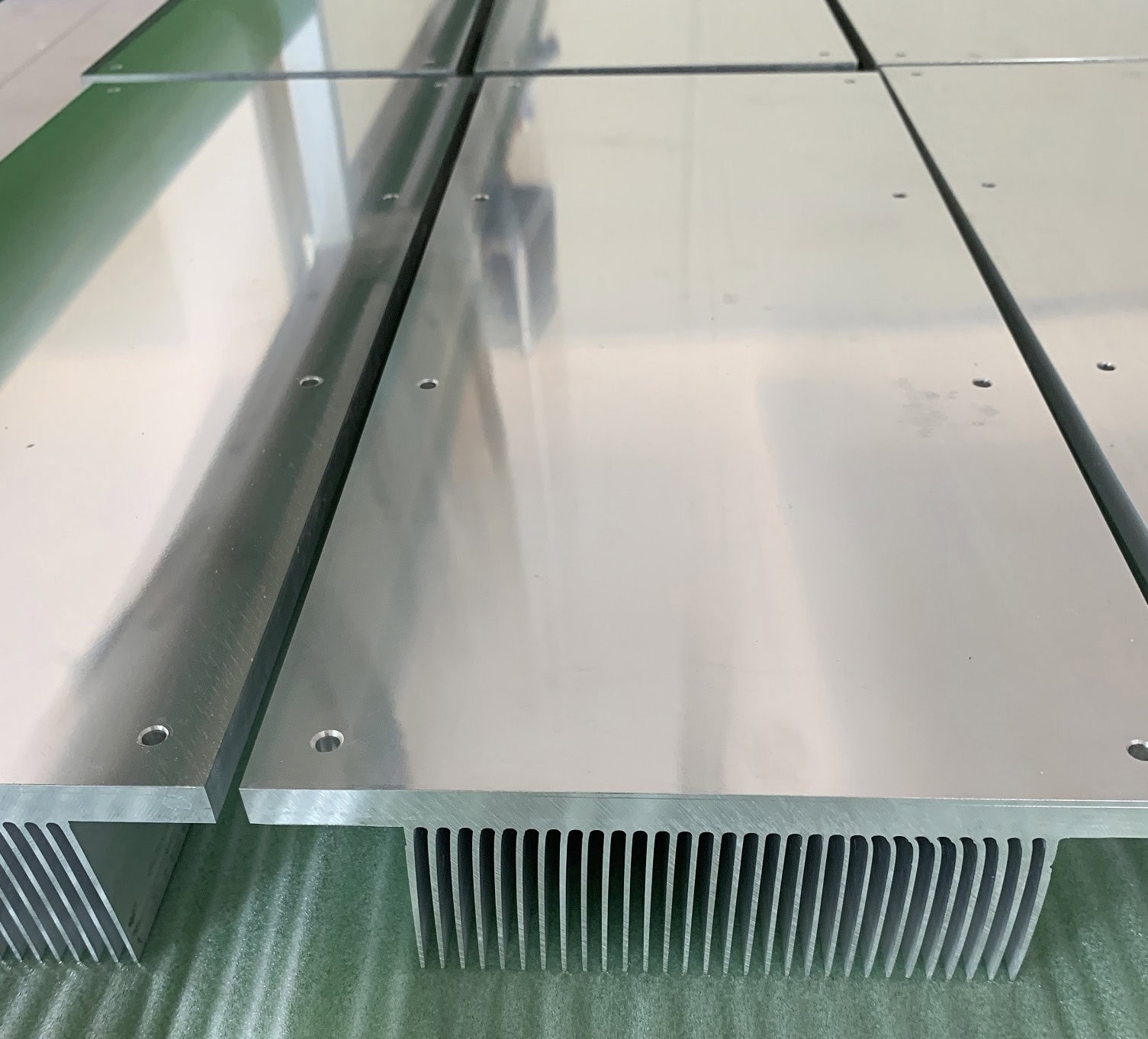
Choosing a heat sink is not only a thermal-design decision. It is also a manufacturing decision.
Two heat sinks may occupy a similar envelope but require very different tooling, materials, fin geometries, secondary machining, and production economics. A design that works well as a prototype may become unnecessarily expensive at 10,000 pieces, while a low-cost high-volume process may require too much upfront tooling for an early-stage project.
For engineers and procurement teams, the goal is therefore not to identify the “best” heat sink manufacturing process. The goal is to select the process that best fits the required thermal performance, airflow, available space, material, mechanical features, production quantity, and target cost.
This guide compares five common manufacturing routes: extrusion, skiving, bonded fin construction, die casting, and cold forging.
Start With the Application, Not the Manufacturing Process
Before deciding how the heat sink should be manufactured, define what the thermal solution must actually accomplish.
The most useful starting information includes:
- Power dissipation or heat load
- Maximum allowable device or case temperature
- Maximum ambient temperature
- Heat-source footprint and location
- Available heat sink length, width, and height
- Natural or forced-air cooling
- Fan airflow and static pressure, when available
- Weight limitations
- Mounting and machining requirements
- Material preference
- Prototype quantity and expected production volume
These inputs often eliminate unsuitable manufacturing methods before detailed design begins.
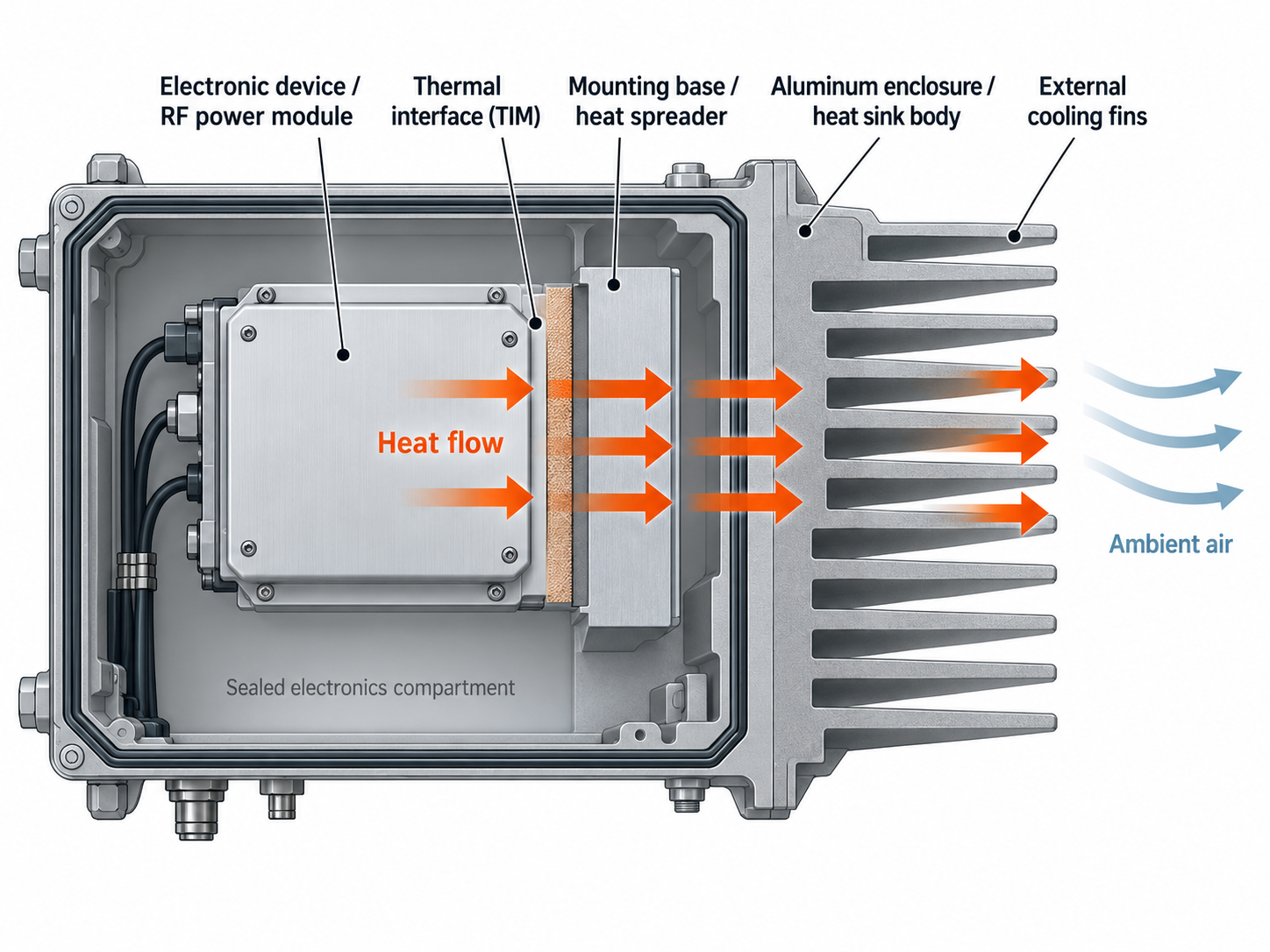
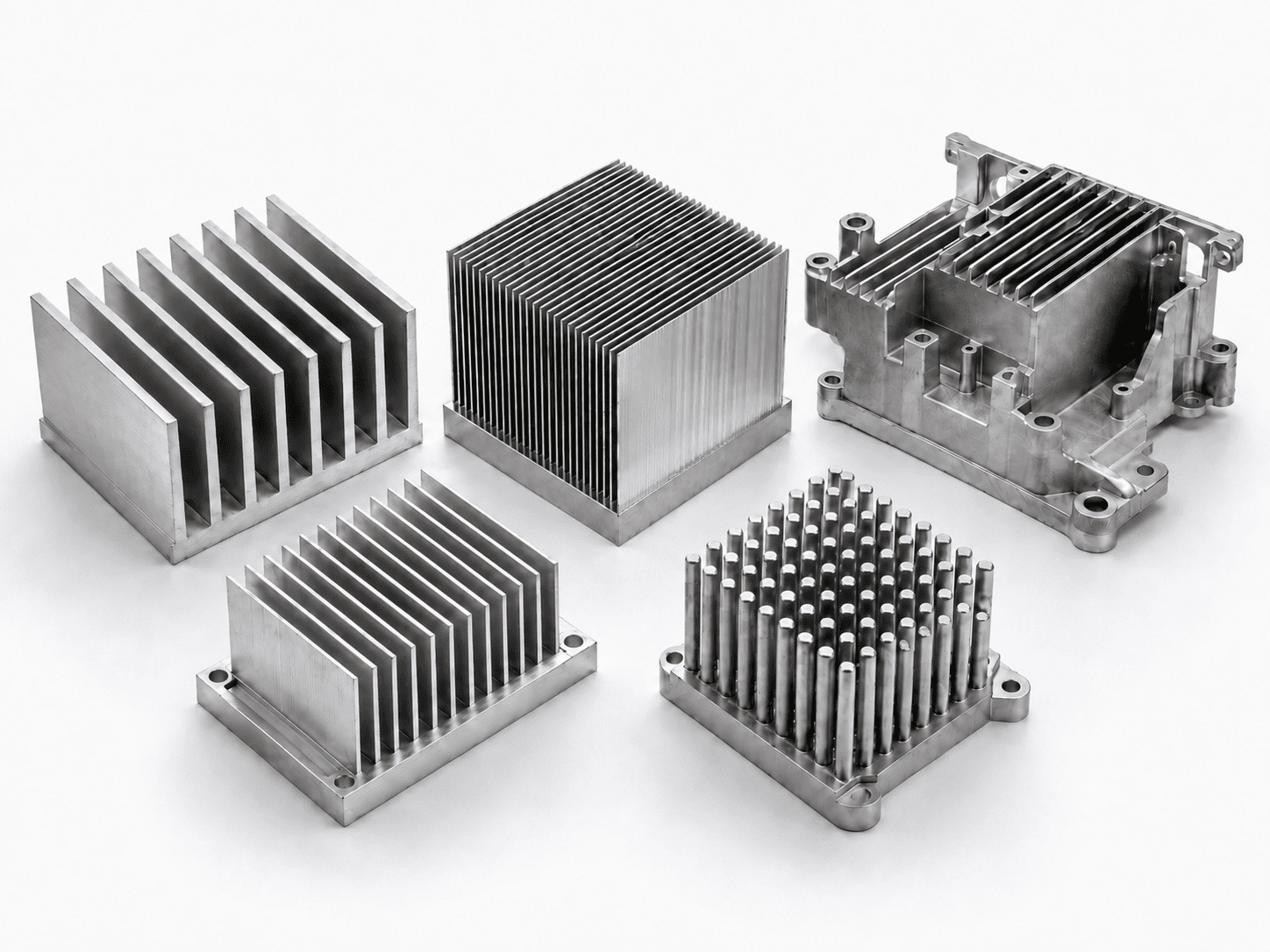
For example, a long straight-fin aluminum design may naturally fit extrusion. A compact design requiring many thin fins may favor skiving. A large air-cooled assembly may be better suited to bonded fins, while a housing that incorporates mounting bosses and cooling fins may justify die casting.
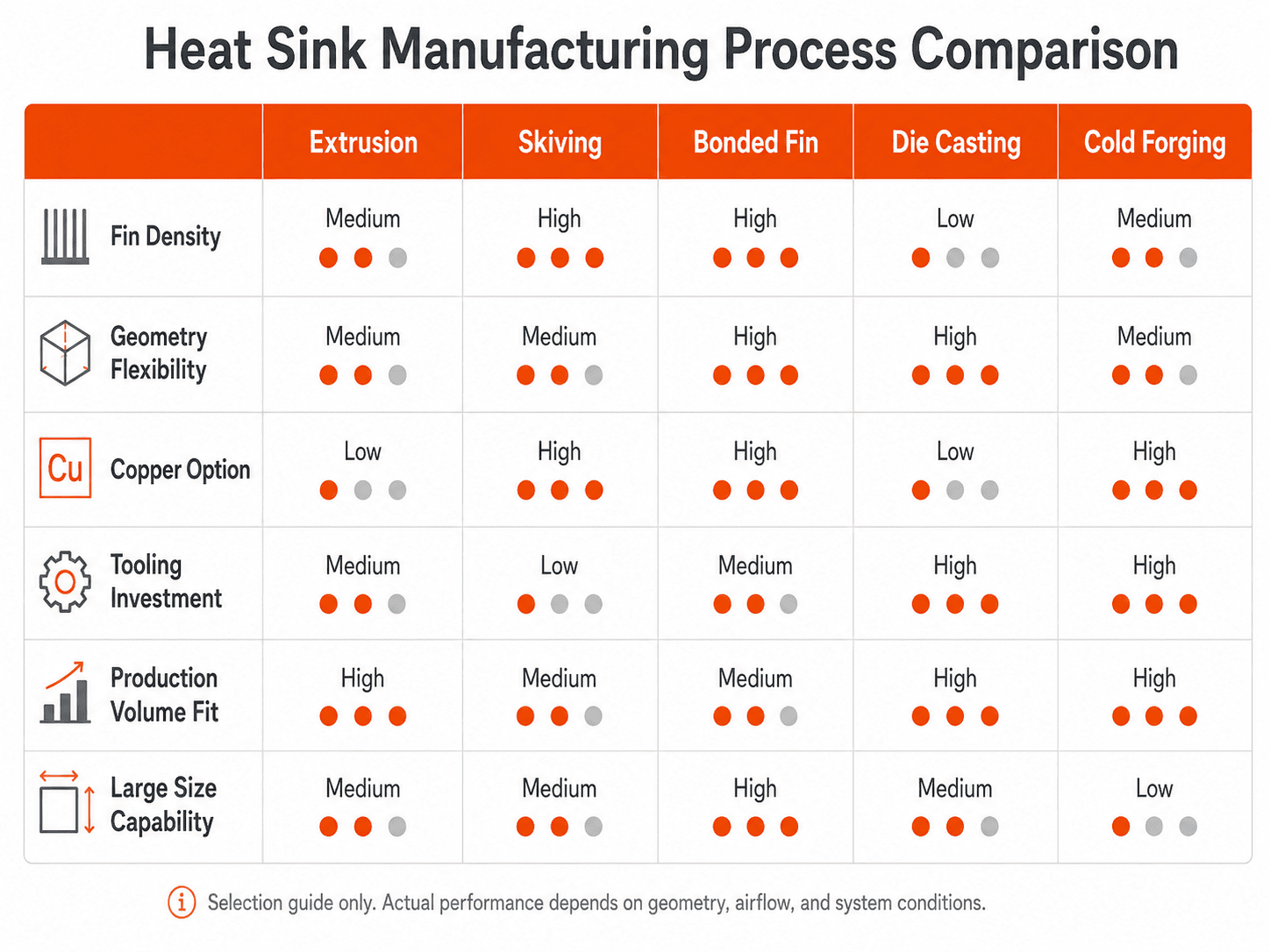
Heat Sink Manufacturing Methods at a Glance
| Process | Strongest Fit | Typical Geometry | Material Options | Production Consideration |
|---|---|---|---|---|
| Extrusion | Cost-effective repeat production | Straight fins, constant cross-section | Primarily aluminum | Requires an extrusion die unless an existing profile is available |
| Skiving | High fin density in limited space | Thin, closely spaced straight fins | Aluminum or copper | No custom extrusion die; machining time affects unit cost |
| Bonded Fin | Large heat sinks and tall fins | High-aspect-ratio fin arrays | Aluminum, copper, or selected combinations | Requires fin-to-base joining and assembly control |
| Die Casting | Complex integrated parts | Fins, housings, bosses, mounting features | Cast aluminum alloys | Higher tooling investment favors larger production runs |
| Cold Forging | Pin-fin and compact one-piece designs | Round, elliptical, or other forged fins/pins | Aluminum or copper | Dedicated tooling favors repeat production |
This table should be treated as a selection guide rather than a performance ranking. Actual thermal performance depends on the complete system, including airflow, fin spacing, material, heat spreading, mounting, and thermal interface resistance.
1. Extruded Heat Sinks: A Practical Starting Point
Aluminum extrusion is one of the most widely used methods for manufacturing heat sinks.
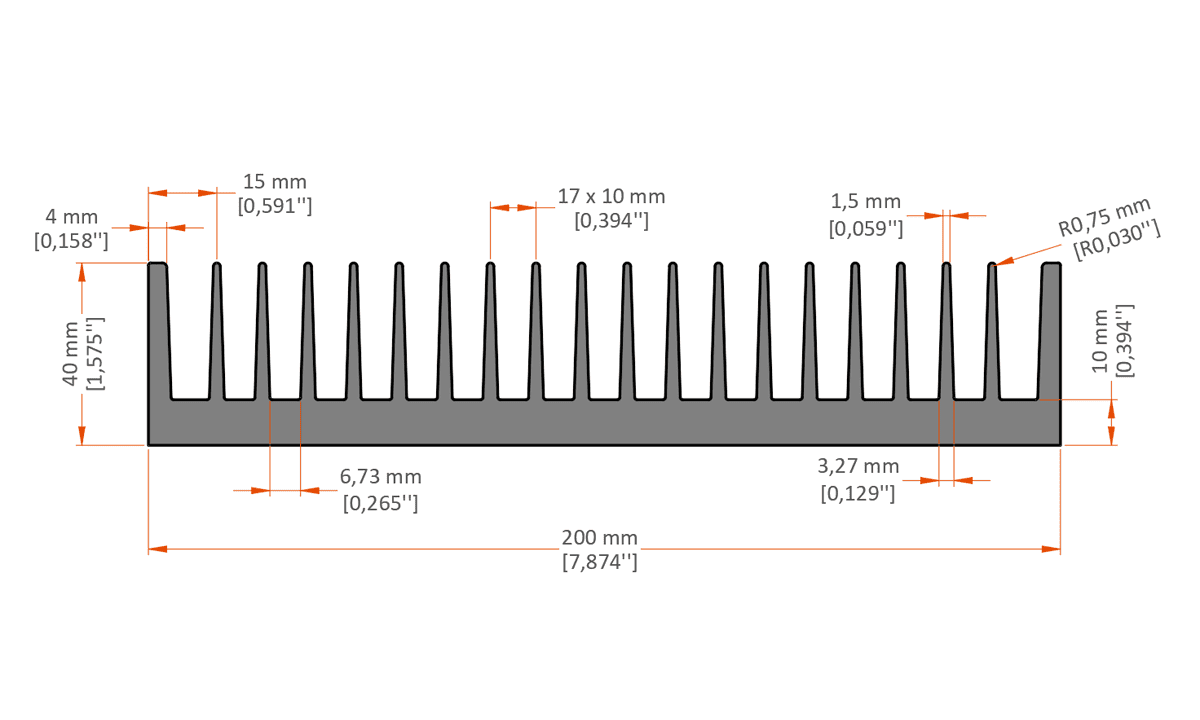
A heated aluminum billet is forced through a die that forms the required cross-section. The resulting continuous profile is then cut to length and can be drilled, tapped, milled, anodized, or otherwise finished.
Extruded heat sinks are particularly effective when the design has a constant cross-section and relatively straight fins.
Consider Extrusion When:
- The design can be produced as a continuous aluminum profile.
- Fin thickness and spacing are within practical extrusion limits.
- You expect repeat or medium-to-high-volume production.
- Mechanical durability is important.
- Secondary CNC machining is required.
- An existing extrusion profile may already fit the project.
Once suitable tooling exists, the same profile can often be cut to different lengths for multiple products. This can make extrusion attractive for product families.
However, extrusion dies impose geometric limitations. Increasing fin height while reducing fin thickness and spacing can eventually make the profile difficult or impractical to extrude.
When the required fin geometry moves beyond those limits, another process may be more appropriate.
For projects that may use an existing extrusion die, you can also browse our existing heat sink extrusion profiles to check available widths, heights, and cross-sections.
2. Skived Heat Sinks: When Fin Density Becomes Important
Skiving begins with a solid aluminum or copper block. A wide precision blade cuts a thin layer from the material and raises it into a fin while leaving the fin connected to the base. The operation repeats to form a dense fin array.
Because the base and fins remain one continuous piece of metal, there is no separate fin-to-base joint.
Consider Skiving When:
- Thin fins and tight fin spacing are required.
- Available width or volume is limited.
- A one-piece copper heat sink is needed.
- Extrusion cannot achieve the required fin geometry.
- You want custom fin geometry without developing an extrusion die.
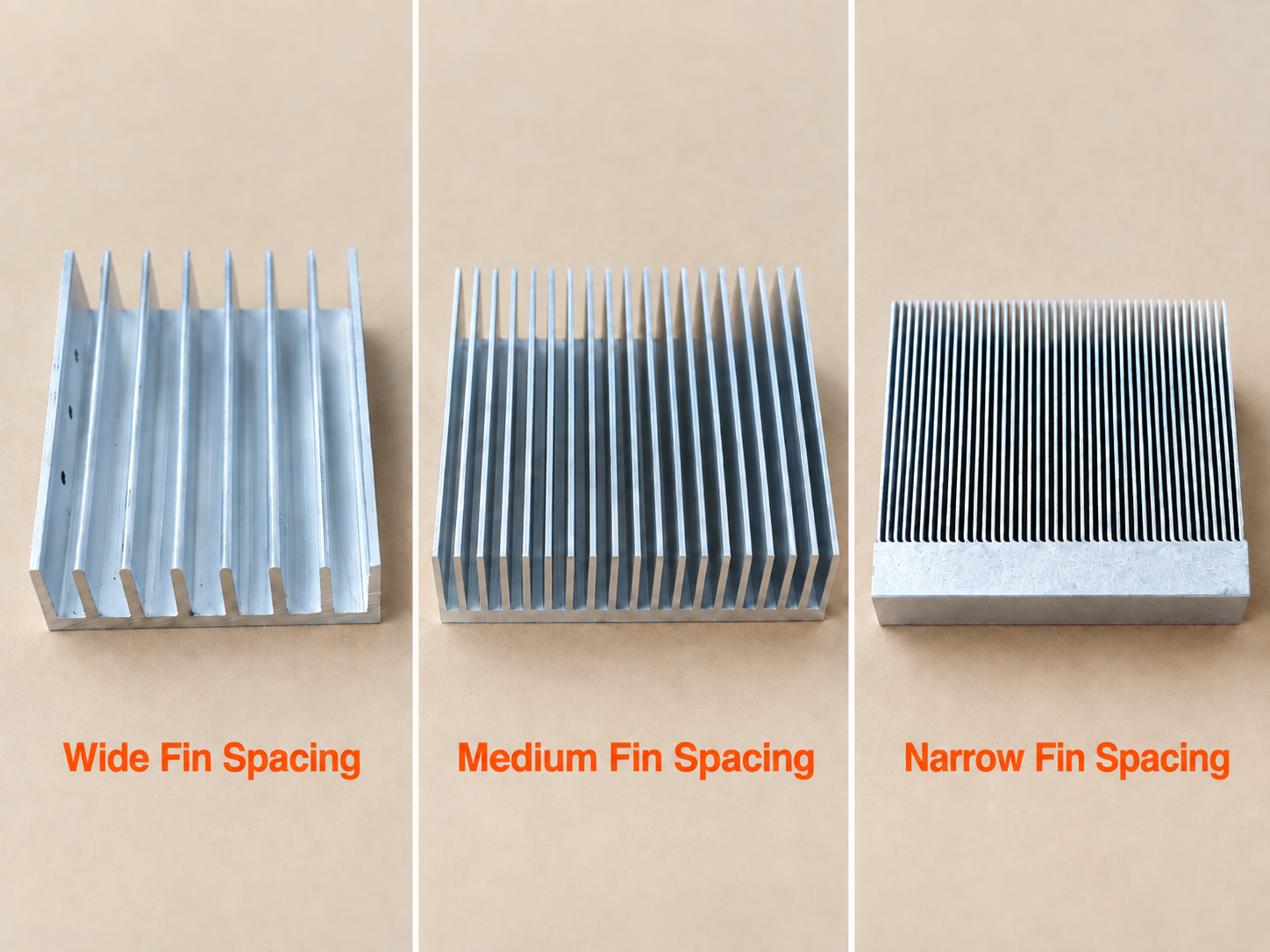
Skived heat sinks can package substantial surface area into a relatively compact envelope. However, higher fin density should not automatically be interpreted as better cooling.
Very narrow channels also increase airflow resistance. Fin spacing must therefore be matched to the available airflow and fan pressure.
For a deeper comparison of these two manufacturing methods, see our guide to extruded vs. skived heat sinks.
3. Bonded Fin Heat Sinks: Useful When the Heat Sink Gets Larger
Bonded fin heat sinks use separately manufactured fins that are inserted into or attached to a base. Depending on material and construction, the fins may be joined using thermally conductive bonding, soldering, brazing, or another appropriate joining process.
Separating the fin and base manufacturing steps removes some of the geometric restrictions associated with one-piece extrusion.
Bonded Fin Construction Is Worth Considering When:
- The heat sink footprint is large.
- Taller fins are required.
- A high fin aspect ratio is needed.
- The required geometry is difficult to extrude.
- The base requires additional machining or thermal features.
This process can be useful for larger forced-air heat sinks used with power electronics and industrial equipment.
The trade-off is manufacturing complexity. Because the fins and base are separate components, joint quality, dimensional consistency, assembly method, and mechanical reliability must all be controlled.
4. Die Cast Heat Sinks: When Thermal and Structural Functions Combine
Die casting takes a different approach. Molten metal is injected into a steel die to create a near-net-shape part.
Instead of manufacturing a heat sink and enclosure separately, die cast heat sinks can sometimes integrate cooling fins with structural features such as:
- Mounting bosses
- Screw locations
- Electronic housings
- Ribs
- Cable or connector features
- External cosmetic surfaces
This can reduce part count and simplify downstream assembly.
Die Casting Is Especially Attractive When:
- The part has complex three-dimensional geometry.
- The heat sink is integrated into an enclosure or housing.
- Dimensional repeatability is important.
- Production volume can justify dedicated tooling.
- Reducing secondary assembly is valuable.
The primary purchasing consideration is tooling.
A die-cast part normally requires a greater initial tooling commitment than a simple extrusion or skived design. Design changes after tooling is completed can also become expensive.
For that reason, die casting generally becomes more attractive once the design is relatively mature and projected production volumes justify the tooling investment.
5. Cold Forged Heat Sinks: A Strong Option for Pin-Fin Designs
Cold forging forms aluminum or copper under high compressive pressure using dedicated tooling.
For heat sinks, the process is particularly useful for producing one-piece pin-fin structures. Depending on the tooling and design, pins can be round, elliptical, or other suitable shapes.
This makes forged heat sinks interesting for applications where airflow may not approach the heat sink from only one direction.
Consider a Forged Heat Sink When:
- A pin-fin structure suits the airflow.
- Air may enter from multiple directions.
- A one-piece aluminum or copper construction is preferred.
- Mechanical robustness is important.
- Production volume can support dedicated forging tooling.
Forging can also be useful when compact geometry and repeatability are priorities.
As with die casting, tooling economics matter. A geometry that looks attractive thermally may not justify custom forging tooling for a very small prototype quantity.
Do Not Choose the Process by Fin Count Alone
A common heat sink design mistake is assuming:
More fins = better cooling.
That is not necessarily true.
Adding fins increases surface area, but reducing the space between fins also increases resistance to airflow.
In natural convection, excessively narrow channels can restrict buoyancy-driven air movement.
In forced convection, dense fins may perform well only when the fan or blower can provide sufficient static pressure to move air through the fin field.
The correct manufacturing process should therefore support the required thermal and airflow design, rather than simply maximize the number of fins.
When Should You Move From an Air-Cooled Heat Sink to a Liquid Cold Plate?
Sometimes the correct answer is not another type of air-cooled heat sink.
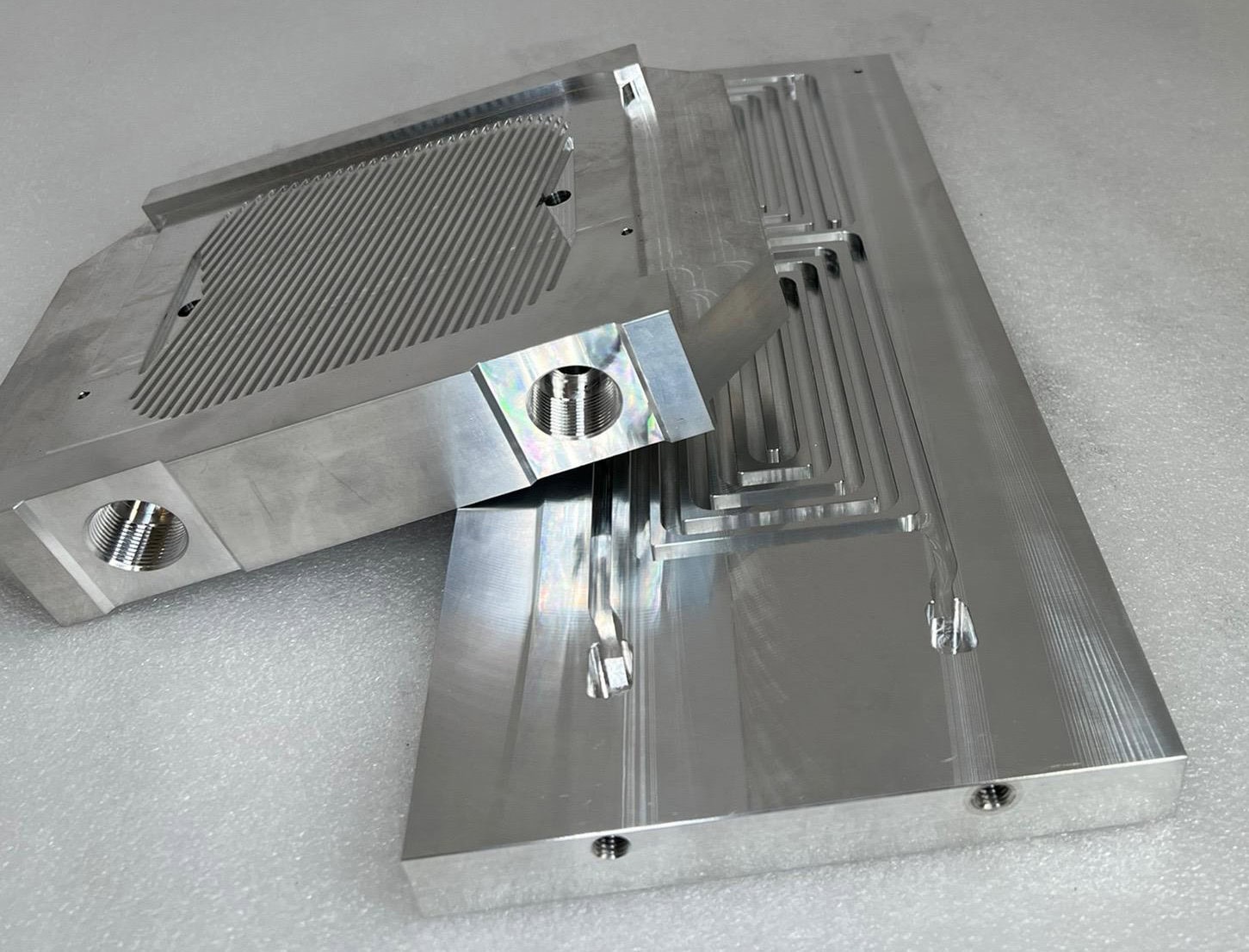
If the required heat load or heat flux cannot be managed within the available space and airflow, a liquid cold plate may be worth evaluating.
A cold plate transfers heat from the device into a circulating coolant through internal channels. It therefore becomes part of a complete liquid cooling loop that normally includes a pump and a heat exchanger.
Liquid cooling introduces additional considerations such as:
- Coolant type
- Flow rate
- Inlet temperature
- Pressure drop
- Internal channel design
- Material compatibility
- Sealing and leak testing
For this reason, moving from an air-cooled heat sink to a cold plate should be treated as a system-level thermal decision rather than simply another manufacturing-process choice.
A Practical Process-Selection Sequence
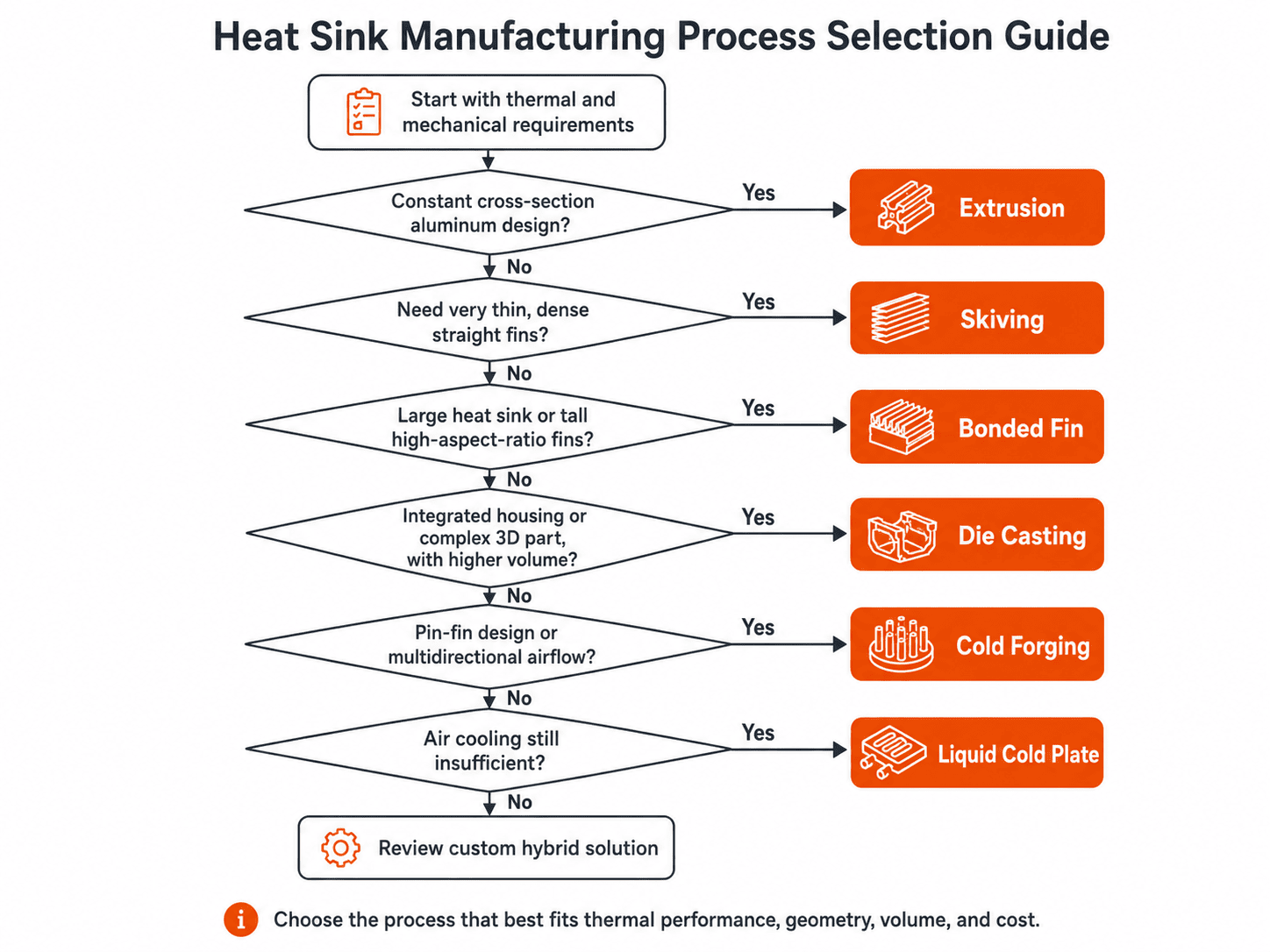
1. Define the Thermal Requirement
Estimate the required thermal resistance using the device heat load, ambient temperature, and allowable device temperature.
2. Define the Airflow
Determine whether cooling is natural convection or forced air. For forced cooling, provide fan airflow and static-pressure information whenever possible.
3. Establish the Available Envelope
Length, width, height, heat-source footprint, and mounting location can quickly determine whether a particular fin construction is realistic.
4. Select the Material
Aluminum is the standard choice for many air-cooled heat sinks because of its balance of thermal performance, weight, manufacturability, and cost.
Copper may be considered when higher thermal conductivity or improved heat spreading is required, but it also increases weight and material cost.
5. Consider Production Volume and Tooling
A process with higher tooling cost may become economical at larger volumes. For prototypes or uncertain annual demand, manufacturing flexibility may be more valuable than the lowest theoretical unit cost.
6. Add Secondary Operations
Do not evaluate only the raw heat sink.
CNC machining, drilling, tapping, surface finishing, inserts, fans, mounting hardware, and assembly requirements can materially affect both process selection and final cost.
The Best Manufacturing Process Is the One That Fits the Whole Project
There is no single heat sink fabrication method that is best for every application.
Use extrusion when a practical aluminum constant-cross-section profile can meet the requirement.
Consider skiving when thinner, denser fins or one-piece copper construction are important.
Evaluate bonded fins for large heat sinks or tall, high-aspect-ratio fin structures.
Use die casting when cooling features need to be integrated into a complex high-volume structural part.
Consider cold forging for one-piece pin-fin designs and applications where multidirectional airflow is useful.
And when air cooling cannot achieve the thermal target within the available envelope, evaluate whether a liquid cold plate is the more appropriate next step.
The manufacturing process should follow the thermal, mechanical, and commercial requirements—not the other way around.
Need Help Selecting a Heat Sink Manufacturing Process?
XINXIANG manufactures custom heat sinks using extrusion, skiving, bonded fin construction, die casting, forging, CNC machining, and liquid cold plate technologies.
Send us your drawing, heat load, available space, airflow conditions, material preference, and estimated production quantity. Send us your heat sink requirements and we can review the manufacturing requirements and help identify a practical process for your project.